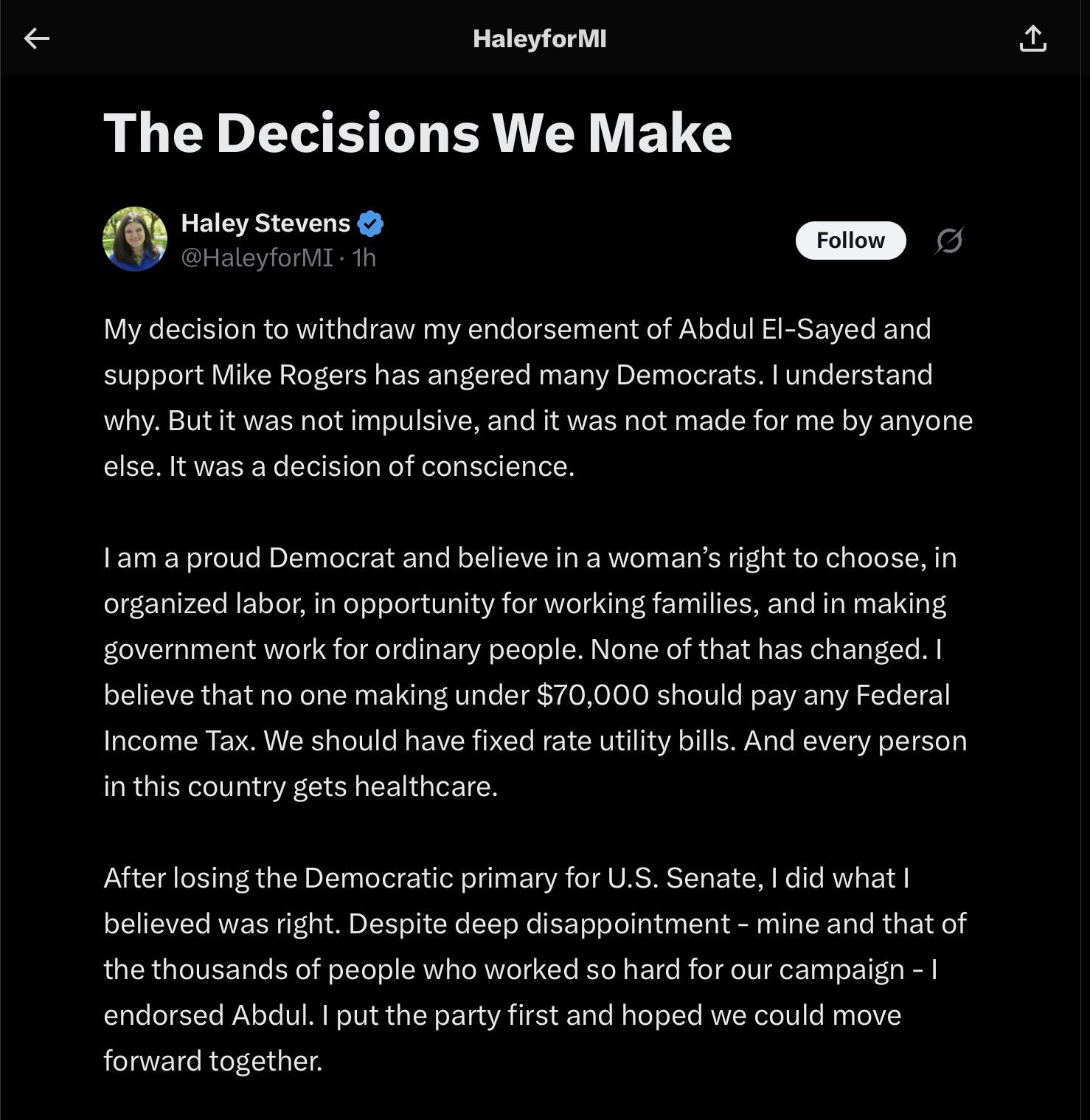
The political landscape in Michigan has been rocked by a surprising move from former Congresswoman Haley Stevens. In a lengthy statement, Stevens announced her decision to withdraw her endorsement of Democratic candidate Abdul El-Sayed and instead back his Republican opponent, Mike Rogers, in the upcoming Senate race. This unexpected shift has sparked intense debate and scrutiny, with many questioning Stevens' motives and the implications for the election.
A Controversial Decision
Stevens' statement, which has been the subject of much discussion, outlines her reasons for the endorsement change. She cites concerns over El-Sayed's stance on Israel and his alleged failure to address certain issues in his campaign. However, the timing and nature of the announcement have raised eyebrows, with some suggesting it was a calculated move to garner attention and others questioning the authenticity of the statement itself.
Authenticity and AI
One of the most intriguing aspects of this story is the speculation that Stevens' statement was written, at least in part, by an AI. This theory is fueled by the language and structure of the text, which some believe bears the hallmarks of artificial intelligence. The use of AI in political messaging is a growing concern, and this incident has brought it to the forefront of the discussion.
"Using AI to increase the word count of your shallow thoughts isn't the flex you think it is, lady."
The writing style, including the use of rhetorical devices and specific phrasing, has led some to believe that Stevens may have used AI assistance. This has sparked a debate about the ethics of AI-generated political statements and the potential impact on the integrity of political discourse.
Political Fallout
The fallout from Stevens' decision has been swift and severe. Many supporters of El-Sayed have expressed disappointment and anger, with some calling her a "sore loser" and accusing her of being "bought and paid for." The move has also been seen as a betrayal of the Democratic Party, with some suggesting that Stevens has burned bridges and may struggle to regain political relevance.
"She's a hollow person - all ego and no morals."
The endorsement of Rogers, a candidate with opposing views on key issues, has been particularly controversial. Critics argue that Stevens' decision to support a candidate who stands against her stated beliefs is a clear indication of her political opportunism.
The Role of Israel
A significant factor in Stevens' decision appears to be El-Sayed's stance on Israel. She expresses concern over his criticism of the country and its policies, which she believes could jeopardize important issues like abortion and unions. This has led to accusations of prioritizing foreign policy over domestic concerns and ignoring the potential consequences of her actions.
"She spells out in great detail that her entire big point was about ads he didn't run and did disavow, which she states and even appreciates. But 'by then' she'd been disinvited to participate in an event. Therefor Abdul is so completely and irredeemably unfit to be a US Senator..."
The discussion around Israel's role in the decision has also brought attention to the broader issue of the country's influence on American politics. Some argue that Stevens' actions are a symptom of a larger problem, where politicians prioritize foreign interests over the needs of their constituents.
The Future of the Senate Race
The impact of Stevens' endorsement change on the Senate race remains to be seen. While some believe it may not significantly affect the outcome, others argue that it could sway undecided voters and potentially damage El-Sayed's campaign. The controversy has certainly added a new layer of complexity to an already heated political contest.
In the end, Stevens' decision has opened a Pandora's box of political intrigue and ethical questions. It remains to be seen how this will shape the future of the Michigan Senate race and the broader political landscape.